
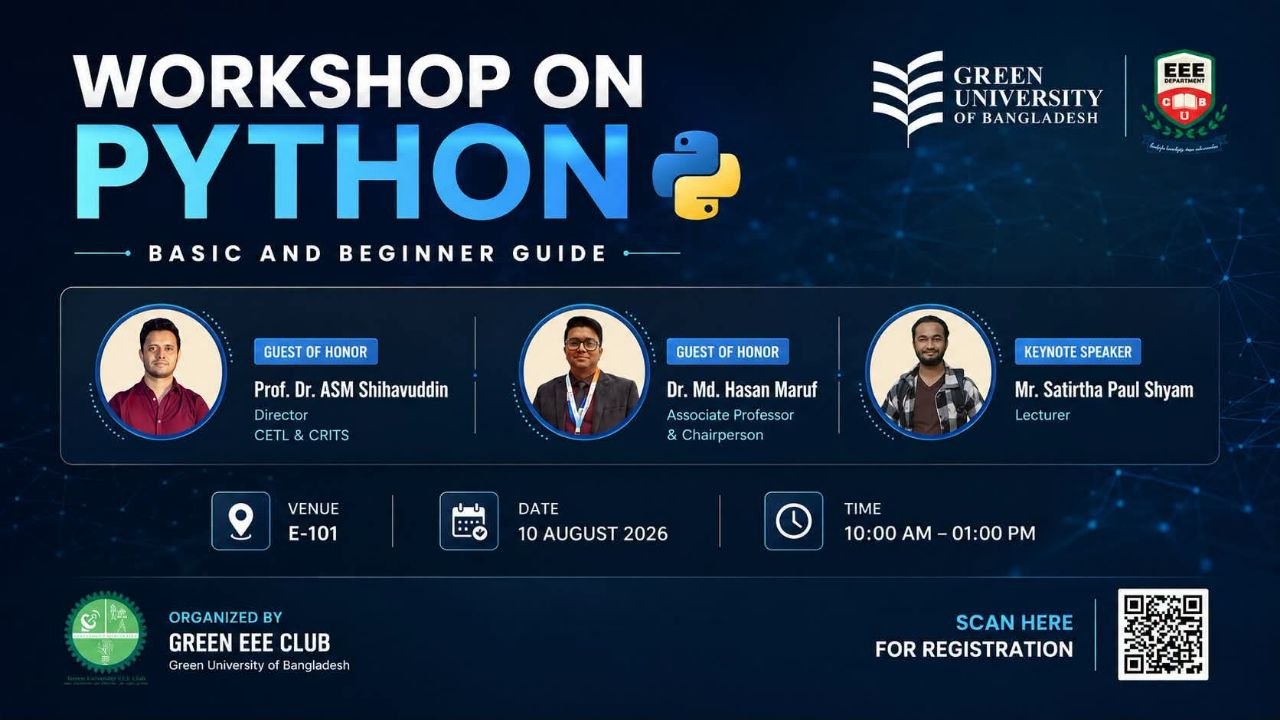
Workshop on Python: Basic and Beginner Guide
The Green EEE Club of the Department of Electrical and Electronic Engineering (EEE), Green University of Bangladesh (GUB) successfully organized the “Workshop on Python: Basic and Beginner Guide” on 10 August 2026 at Room E-101, Green University of Bangladesh. The workshop was designed to introduce students to the fundamentals of Python programming and provide them with hands-on experience in applying Python to programming, data analysis, image and audio processing, machine learning, and artificial intelligence.
The workshop featured Mr. Satirtha Paul Shyam, Lecturer, as the Keynote Speaker, who conducted interactive and practical sessions throughout the event. The program was also graced by Prof. Dr. ASM Shihavuddin, Director of CETL & CRITS, and Dr. Md. Hasan Maruf, Associate Professor and Chairperson of the Department of EEE, as Guests of Honor.


The workshop began with the fundamentals of Python programming, including data types, operators, conditional statements, loops, and functions, before progressing to more advanced programming concepts such as exception handling and object-oriented programming. Participants were given opportunities to write and execute code themselves, allowing them to develop their programming skills through direct practice.


The sessions then explored Python’s applications in data processing and visualization. Participants worked with TXT and CSV files, processed datasets using Pandas, and created visualizations using Matplotlib. The workshop subsequently introduced image processing with OpenCV, where participants experimented with various edge-detection techniques, including Sobel, Prewitt, Canny, Laplacian, Scharr, Roberts, and Difference of Gaussians (DoG).


The workshop also demonstrated Python’s capabilities in audio processing using Librosa. Participants explored practical techniques such as audio stretching, reversing, pitch shifting, echo effects, and audio remixing, providing them with an engaging understanding of how programming can be applied to multimedia processing.


The workshop concluded with an introduction to machine learning and neural networks. Participants implemented a Multi-Layer Perceptron (MLP) using PyTorch and experienced the complete workflow of training, testing, prediction, and model evaluation. The final sessions also provided an introduction to pretrained deep-learning models and AI-powered image processing, exposing participants to contemporary applications of Python in artificial intelligence.


A key strength of the workshop was its hands-on learning approach. Rather than simply observing demonstrations, participants actively wrote, executed, modified, and debugged the codes on their own computers. This practical approach enabled them to observe how changes in code and parameters directly influenced the outcomes and helped bridge the gap between theoretical concepts and real-world applications.
Latest Events
Find Us
- Purbachal American City, Kanchan, Rupganj, Narayanganj-1461, Dhaka, Bangladesh
+880-9614-482482, 01324-713502, 01324-713503, 01324-713504, 01324-713505, 01324-713506, 01324-713507, 013247-13508
- addmission@green.edu.bd
Departments
Centers
- Center for Career Development (CCD)
- Center for Language and Cultural Studies (CLCS)
- Center For Research Innovation and Transformation and Sustainability(CRITS)
- Center for International Affairs (GCIA)
- Center of Excellence for Teaching And Learning (CETL)
- Center for Continuing Education (CCE)
- Institutional Quality Assurance Cell(IQAC)
Offices
- Office of the Vice Chancellor
- Office of the Pro Vice Chancellor
- Office of the Treasurer
- Office of the Registrar
- Office of the Exam Controller
- Office of the Admission
- Office of the Accounts
- Office of the GCITS
- Office of the Proctor
- Office of the Library
- Coordination Office
- Office of the Public Relation
- Office of the Student Affairs
- Medical Center
- Office of Logistics
- Others Office
© 2003-2026 Green University of Bangladesh. All Rights Reserved.
Developed by GCITS